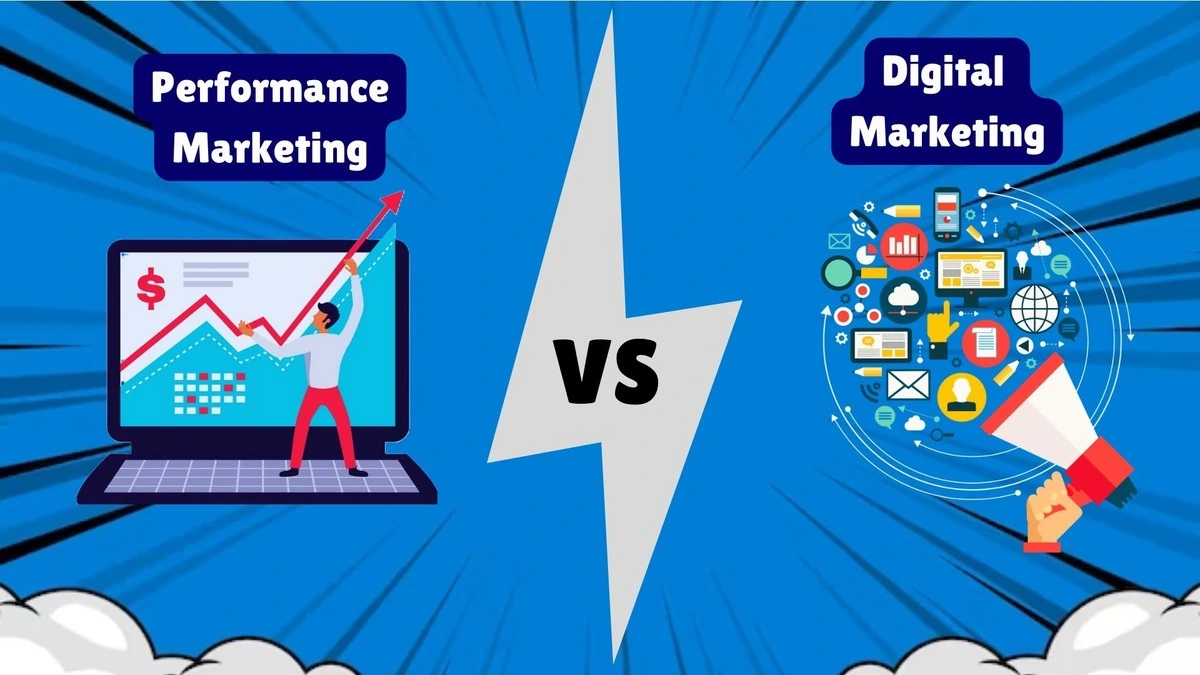
Every marketer eventually faces the same crossroads: should you invest in performance marketing, which promises measurable, results-driven outcomes, or broaden your horizon with a full digital marketing strategy that builds lasting brand equity alongside direct response?
Table of Contents
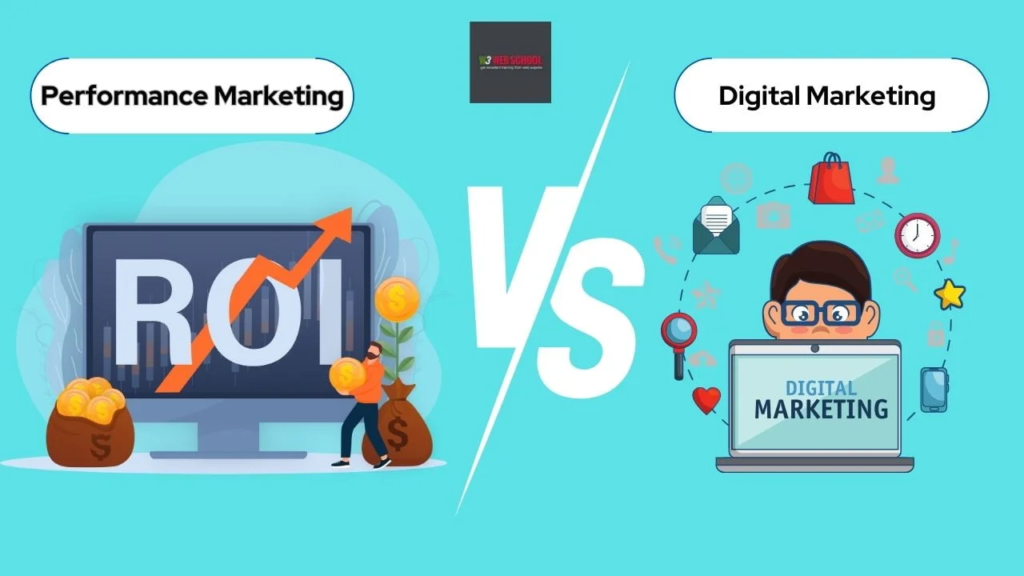
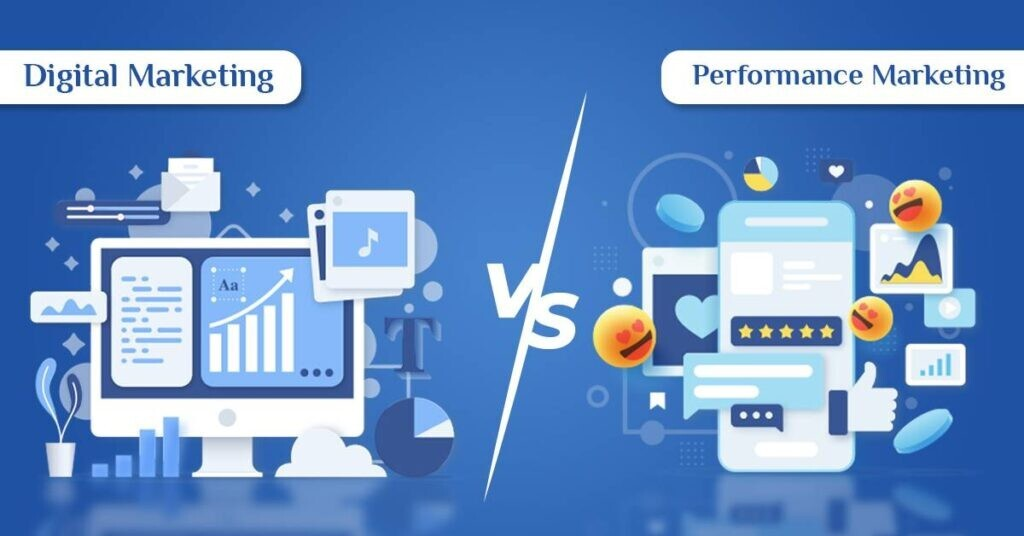
The confusion is understandable. The two terms overlap significantly in channels, tools, and tactics. Performance marketing is, in fact, a subset of digital marketing. Yet the distinction between them matters enormously when you are allocating budget, building a team, or pitching a strategy to leadership.
This guide cuts through the noise. You will find clear definitions, a side-by-side comparison, a breakdown of channels and metrics, real-world use cases, and a framework to help you decide which approach, or which blend, is right for your business right now.
| WHY THIS COMPARISON MATTERS The core tension: Performance marketing optimizes for what you can measure today. Digital marketing also invests in what will pay dividends tomorrow. Both are valid. Neither is complete without the other. |
What Is Digital Marketing?
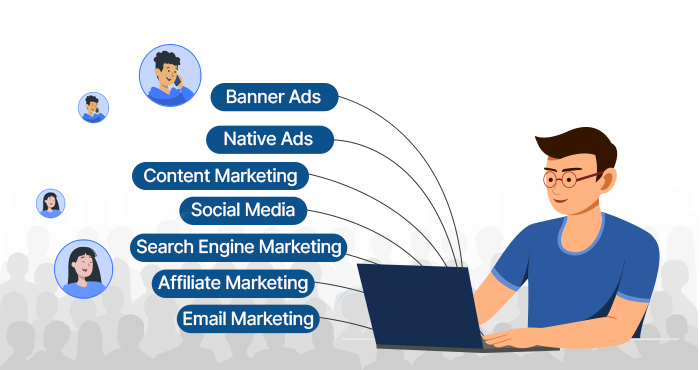
Digital marketing is the umbrella term for all marketing activities conducted through digital channels, including search engines, social media, email, websites, mobile apps, podcasts, and connected TV. Its goals range from brand awareness and community building to lead generation and direct sales.
Digital marketing encompasses both paid and organic tactics. A company that publishes an SEO-optimized blog, runs Google Ads, manages an Instagram account, sends newsletters, and partners with influencers is practicing digital marketing in its fullest sense.
Key characteristics of digital marketing:
- Broad scope covering awareness, consideration, and conversion stages
- Mix of short-term and long-term objectives
- Includes both paid media and owned/earned channels
- Success measured by a blend of brand and performance metrics
- Requires cross-functional teams (content, design, paid media, analytics)
What Is Performance Marketing?
Performance marketing is a results-first discipline within digital marketing where advertisers pay only, or primarily, when a defined action occurs. That action could be a click, a lead, a sale, an install, or a subscription. The emphasis is on accountability: every rupee or dollar spent must trace back to a measurable outcome.
Performance marketing typically operates through paid channels such as pay-per-click (PPC) search advertising, paid social, programmatic display, affiliate networks, and performance-based influencer deals.
Key characteristics of performance marketing:
- Payment tied directly to measurable results (CPC, CPL, CPA, CPS)
- Heavy reliance on data, A/B testing, and real-time optimization
- Focus on conversion funnels and attribution modeling
- Faster feedback loops, often measurable within days or weeks
- Scalable when a profitable unit economics model is established
| ANALOGY Think of digital marketing as the entire ocean and performance marketing as a fleet of ships optimized for speed and precision navigation. You need the ocean to exist, but the ships get you to your destination fastest. |
Performance Marketing vs Digital Marketing: Side-by-Side Comparison
The table below summarizes the most important dimensions on which the two approaches differ.
| Criteria | Performance Marketing | Digital Marketing |
| Primary Goal | Drive measurable ROI | Build brand & awareness |
| Budget Model | Pay for results (CPA, CPC) | Pay for exposure (CPM, flat) |
| Measurement | Highly trackable KPIs | Mix of hard/soft metrics |
| Timeline | Short- to mid-term | Mid- to long-term |
| Risk Level | Lower (pay per result) | Higher (upfront spend) |
| Channels | PPC, affiliate, paid social | SEO, content, social, email |
| Best For | Revenue & lead generation | Awareness & brand growth |
| Scalability | Highly scalable with data | Scalable over time |
It is important to stress that these are not binary opposites. Most mature marketing organizations blend both approaches, using performance marketing to drive near-term revenue while investing in digital marketing fundamentals, such as content, SEO, and brand, to reduce long-term customer acquisition costs.
Channels, Metrics, and Cost Models
Understanding which channels belong to each discipline, and how success is measured in each, is critical for budget allocation and team structure.
| Channel | Primary Goal | Key Metric | Cost Model Risk |
| Google Ads (PPC) | Traffic, conversions | CPC / ROAS | High |
| Meta Ads | Leads, sales | CPL / CPA | High |
| Affiliate Marketing | Sales | CPS / revenue share | Medium |
| Programmatic Display | Awareness + retargeting | CPM / CPA | Medium |
| Influencer (perf.) | Sales + awareness | CPS / promo code | Medium |
| Email Marketing | Retention, upsell | Revenue / open rate | Low |
| SEO / Content | Organic traffic | Rankings / leads | Low |
| Social Media (organic) | Engagement, brand | Reach / shares | Low |
A Note on Channel Overlap
Many channels appear in both performance and broader digital marketing contexts. Paid social (Meta Ads, LinkedIn Ads) can be run as strict direct-response campaigns optimized for cost-per-lead, or as brand awareness campaigns measured by reach and video views. The channel does not determine the discipline; the strategy and measurement framework do.
How Performance Marketing Works: The Core Mechanics
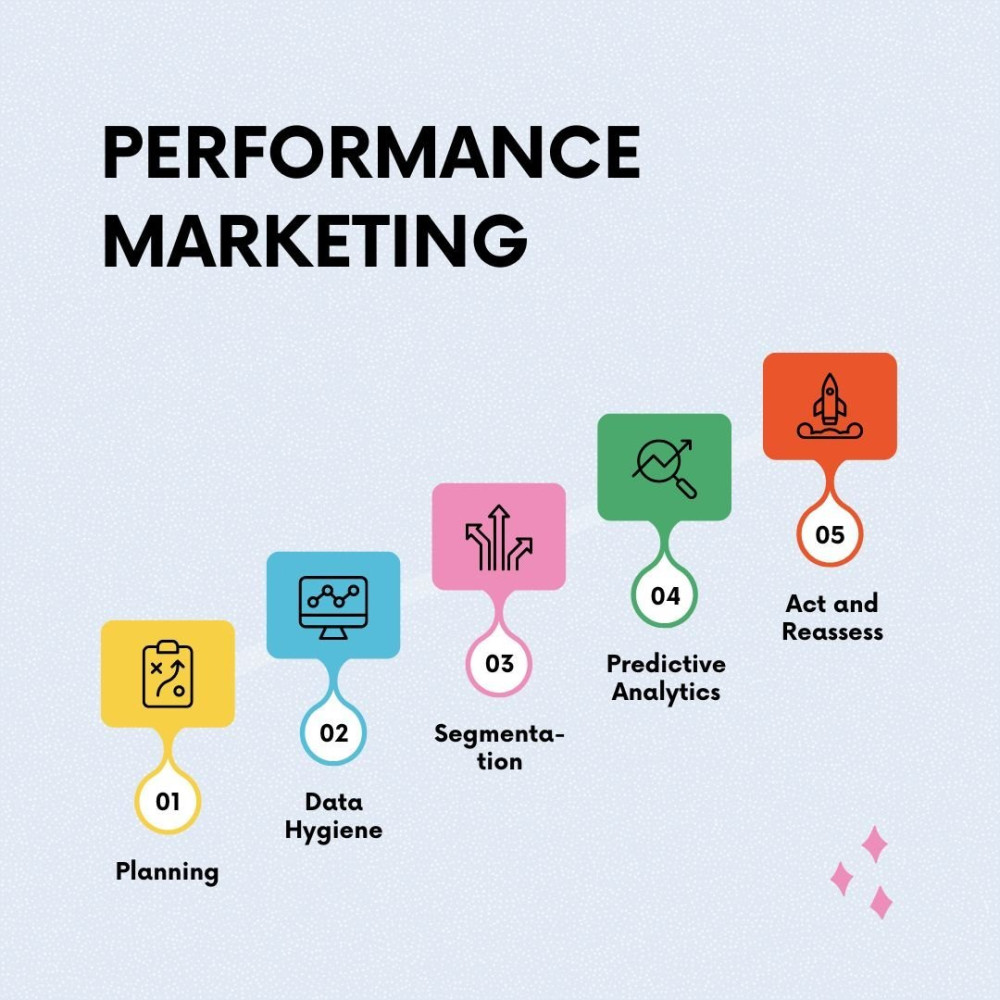
1. Setting a Performance Goal
Every performance campaign begins with a precise, quantifiable objective. Common goals include a target cost per acquisition (CPA), a minimum return on ad spend (ROAS), a cost per lead (CPL), or a cost per install (CPI) for mobile apps. Without a defined target, there is no way to determine whether a campaign is performing.
2. Choosing the Right Channel and Audience
Performance marketers select channels based on where their target audience demonstrates buying intent or behavioral signals. Google Search captures demand that already exists. Meta and Instagram create demand by reaching users based on interests and demographics. Affiliate networks leverage third-party publishers who have built trusted audiences in specific niches.
3. Building and Testing Creative
Ad creative, landing pages, and offer structures are continuously tested in performance marketing. A/B testing ad copy, headlines, images, calls-to-action, and landing page layouts is standard practice. The goal is to find combinations that convert at or below the target CPA while maintaining acceptable traffic quality.
4. Attribution and Tracking
Performance marketing depends entirely on accurate attribution. Without proper tracking, there is no way to know which ad, keyword, audience segment, or creative drove a conversion. Common attribution models include last-click, first-click, linear, time-decay, and data-driven attribution. Multi-touch attribution has become increasingly important as customer journeys span multiple devices and sessions.
Technical implementation typically involves:
- Conversion pixels or tags (Google Tag Manager, Meta Pixel)
- UTM parameters on all ad URLs
- Server-side tracking to address browser privacy restrictions
- Third-party attribution platforms (AppsFlyer, Adjust, Rockerbox, Northbeam)
5. Optimization and Scaling
Once a campaign achieves a profitable CPA or ROAS, performance marketers scale spend systematically. Budget is reallocated from underperforming ad sets to top performers. Lookalike audiences based on existing converters are tested. Bid strategies may shift from manual to automated (smart bidding) as the algorithm accumulates enough conversion data. Successful creative is refreshed before fatigue causes performance to decline.
How a Full Digital Marketing Strategy Works
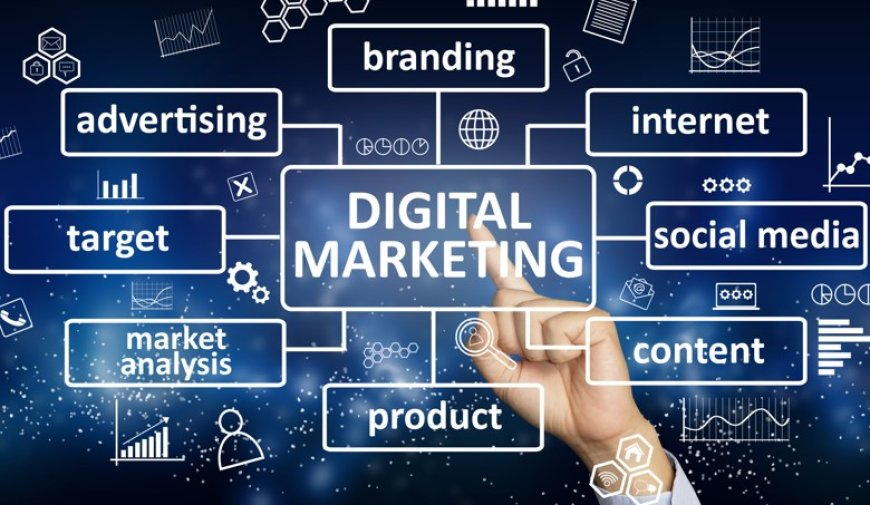
The Customer Journey Framework
Digital marketing maps to the entire customer journey, from the first moment a potential customer becomes aware of a problem through to post-purchase advocacy. While performance marketing is strongest at the consideration and conversion stages, digital marketing also covers:
- Awareness: SEO, content marketing, social media, display advertising, video
- Consideration: Email nurture sequences, retargeting, comparison content, reviews
- Conversion: PPC, conversion rate optimization (CRO), affiliate marketing
- Retention: Email marketing, loyalty programs, personalization, community
- Advocacy: Referral programs, user-generated content, review management
Owned, Earned, and Paid Media
A robust digital marketing strategy balances three media types:
Owned media refers to channels the brand controls entirely: its website, blog, email list, social profiles, and mobile app. Investment in owned media builds long-term assets that compound over time. A piece of evergreen content ranking on page one of Google can generate free organic traffic for years.
Earned media is coverage and mentions the brand receives without paying directly: press mentions, organic social shares, user reviews, and word-of-mouth referrals. Earned media is the hardest to control but often the most credible.
Paid media covers any channel where visibility is purchased: search ads, social ads, programmatic display, sponsored content, and influencer partnerships. Performance marketing primarily operates within paid media, though performance-based influencer deals also generate a form of earned visibility.
| STRATEGIC INSIGHT Companies that invest heavily in owned and earned media over time gradually reduce their dependence on paid media, lowering customer acquisition costs and improving long-term profitability. This is why digital marketing strategy, not just performance marketing, matters. |
Key Metrics: Performance Marketing vs Digital Marketing
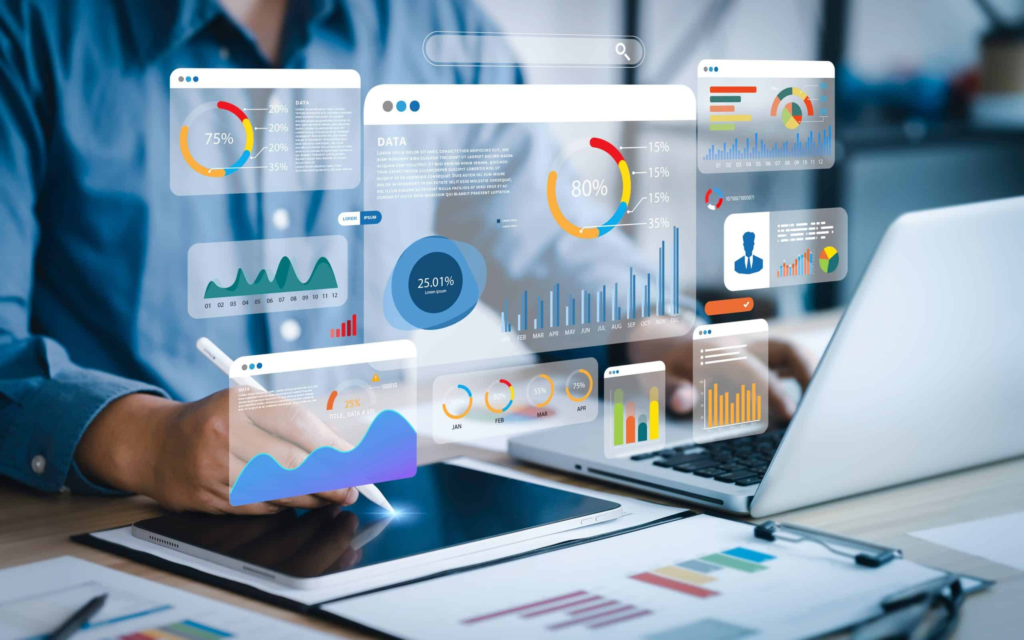
Performance Marketing KPIs
- CPC (Cost Per Click): Total spend divided by number of clicks.
- CPL (Cost Per Lead): Total spend divided by number of leads generated.
- CPA (Cost Per Acquisition): Total spend divided by conversions (purchases, sign-ups, etc.).
- ROAS (Return on Ad Spend): Revenue generated divided by ad spend.
- CTR (Click-Through Rate): Clicks divided by impressions.
- Conversion Rate: Conversions divided by clicks or landing page visitors.
- LTV:CAC Ratio: Customer lifetime value divided by customer acquisition cost.
- POAS (Profit on Ad Spend): Gross profit generated divided by ad spend.
Broader Digital Marketing KPIs
- Organic traffic: Visitors from non-paid search results.
- Domain authority / search rankings: Indicator of long-term SEO health.
- Email list growth and open/click rates: Health of owned audience.
- Social media reach, engagement rate, follower growth.
- Brand search volume: How often people search for the brand directly.
- Net Promoter Score (NPS): Customer satisfaction and likelihood to recommend.
- Share of voice: Brand’s visibility relative to competitors across channels.
- Content marketing ROI: Leads and revenue attributed to content assets.
Pros and Cons of Each Approach
Performance Marketing: Advantages
- Accountability: Every dollar is tracked to an outcome, making ROI transparent.
- Speed: Campaigns can be live within hours and generating data within days.
- Flexibility: Budgets can be paused, scaled, or redirected quickly based on results.
- Scalability: A proven CPA model can be scaled aggressively with additional budget.
- Low waste: Paying only for results reduces the risk of ad spend with no return.
Performance Marketing: Disadvantages
- Short-termism: Constant optimization for immediate conversions can underinvest in brand building, which drives long-term pricing power and lower CAC.
- Attribution complexity: Multi-touch journeys are hard to attribute accurately, leading to budget decisions based on last-click data that undervalue upper-funnel channels.
- Platform dependency: Heavy reliance on Google or Meta creates vulnerability to policy changes, privacy updates (iOS, cookie deprecation), and auction price inflation.
- Creative fatigue: Performance channels require constant creative refresh, demanding significant ongoing investment in creative production.
- Margin pressure: As channels mature, competition drives up CPCs and CPMs, compressing margins over time.
Full Digital Marketing Strategy: Advantages
- Brand equity: Sustained brand investment builds recognition, trust, and pricing power that reduce sensitivity to ad spend fluctuations.
- SEO compounding: Organic search rankings built through content marketing generate traffic without incremental cost per click.
- Audience ownership: An email list or loyalty community is a direct channel immune to algorithm changes.
- Customer retention: Email, content, and community keep customers engaged and increase lifetime value.
- Resilience: A diversified channel mix is less vulnerable to any single platform’s policy changes.
Full Digital Marketing Strategy: Disadvantages
- Longer time-to-results: SEO and content marketing often take 6 to 18 months to show meaningful return.
- Harder to attribute: Brand campaigns and content marketing do not always produce trackable last-click conversions.
- Resource intensity: Executing across multiple channels simultaneously requires larger teams or agencies.
- Measurement complexity: Proving the ROI of brand investment to leadership can be difficult without sophisticated measurement infrastructure.
Real-World Use Cases: When to Choose Which
When Performance Marketing Is the Right Primary Focus
Performance marketing should be your priority when:
- You are an early-stage startup that needs to prove product-market fit quickly and generate revenue to survive.
- You are launching a new product and need immediate demand validation without waiting months for organic results.
- You are in a highly transactional category where customers are already searching for what you sell (e.g., insurance, travel, software trials).
- You have a product with a short consideration cycle where people can be taken from discovery to purchase in a single session.
- Your CFO or board demands a clear, measurable return on every marketing dollar before approving budget increases.
- You have a validated unit economics model (LTV:CAC > 3:1) and need to scale it efficiently.
When a Broader Digital Marketing Strategy Is Essential
Invest in a broader digital marketing strategy when:
- You operate in a high-consideration category (B2B software, financial services, healthcare) where trust must be built over weeks or months before a decision is made.
- Your performance channels are hitting a ceiling because your brand awareness is insufficient to convert cold traffic profitably.
- You are building a consumer brand where perception, community, and cultural relevance drive purchase decisions more than direct response ads.
- You want to reduce long-term CAC by building organic traffic and owned audiences that reduce dependence on paid channels.
- You are in a competitive category where top-of-funnel content and SEO can generate significant qualified traffic at zero marginal cost per visit.
The Balanced Approach: When to Do Both
Most businesses at growth stage and beyond benefit from a portfolio approach that allocates budget across both performance and brand channels based on their current growth priorities, unit economics, and competitive context. A common framework:
- 60 to 70% of budget on performance channels (PPC, paid social, affiliate) to drive near-term revenue.
- 20 to 30% on content, SEO, and email to build compounding, lower-cost organic channels.
- 10% on brand experiments (video, influencer, sponsorships) to test what builds long-term equity most efficiently.
As the business matures and organic channels scale, the performance marketing share of budget can decrease while maintaining or growing revenue, improving overall marketing efficiency.
How to Choose the Right Strategy for Your Business
Step 1: Clarify Your Primary Business Objective
Are you trying to generate revenue immediately, build a brand over time, reduce customer acquisition cost, or all three at different priorities? Your answer should drive your channel mix.
Step 2: Assess Your Current Funnel
Do you have enough brand awareness to convert paid traffic profitably? If your conversion rates on performance channels are poor, it may be a demand generation problem that needs brand and content investment, not more performance spend.
Step 3: Analyze Your Category
Is your product bought impulsively or after months of research? Performance marketing excels for impulsive, transactional purchases. High-consideration purchases need nurture, content, and trust-building that performance channels alone cannot provide.
Step 4: Evaluate Your Resources
Performance marketing requires budget, technical tracking infrastructure, and analytical expertise. Content and SEO require time and creative resources. Be honest about what you can execute well with your current team.
Step 5: Define Your Measurement Framework Before You Spend
Decide in advance what success looks like, what KPIs you will track, over what time horizon, and with what attribution methodology. This prevents the common mistake of measuring long-term brand investments with short-term performance benchmarks, or vice versa.
The Future of Performance and Digital Marketing
Privacy Changes Are Reshaping Performance Marketing
The deprecation of third-party cookies, Apple’s App Tracking Transparency (ATT) framework, and increasing browser-level tracking restrictions are making traditional pixel-based performance marketing attribution less reliable. Advertisers are responding by investing in first-party data strategies, server-side tracking, modeled conversions, and incrementality measurement to supplement last-click attribution.
AI Is Transforming Campaign Management
Google’s Performance Max, Meta’s Advantage+ Shopping Campaigns, and similar AI-driven campaign types are automating audience targeting, bidding, and creative optimization at a scale no human team can match. Performance marketers are shifting focus from tactical campaign management to strategic inputs: feeding algorithms high-quality first-party data, setting accurate conversion values, and producing diverse creative assets for testing.
The Blurring of Brand and Performance
The industry is increasingly recognizing that the strict separation of brand and performance budgets is a false dichotomy. Connected TV, YouTube, and creator marketing are proving that brand-building channels can also drive measurable direct response outcomes. The most sophisticated marketing organizations are moving toward unified measurement that captures both immediate and delayed revenue contribution of all channels.
Content and Community as Competitive Moats
As paid media costs continue to rise due to auction competition and privacy-driven signal loss, brands that have invested in content, SEO, email lists, and community have a durable advantage. Digital marketing fundamentals are becoming a strategic moat, not just a tactical option.
| THE STRATEGIC TAKEAWAY The winners in the next decade of marketing will be those who use performance marketing to generate the revenue needed to fund brand and content investment, and use brand and content to reduce their dependence on performance marketing over time. It is not either/or. It is a virtuous cycle. |
Conclusion: Performance Marketing and Digital Marketing Are Partners, Not Rivals
The debate between performance marketing and digital marketing is, ultimately, a false choice. Performance marketing provides the accountability, speed, and scalability that businesses need to generate revenue in the short term. A broader digital marketing strategy builds the brand awareness, organic traffic, and owned audiences that lower customer acquisition costs and create sustainable competitive advantage over time.
The most successful marketing organizations treat these two approaches as complementary layers of a unified growth strategy: using performance channels to fund growth today while systematically investing in digital marketing fundamentals that will make performance channels more efficient tomorrow.
Whether you are a founder deciding where to spend your first marketing budget, a CMO rethinking your channel mix, or a marketer building your skills, the key is to understand both disciplines deeply, measure everything rigorously, and resist the temptation to treat any single channel or strategy as a silver bullet.
The brands that win are those that master both: performing today, and building for tomorrow.
FAQ’s
Neither is better in absolute terms. Performance marketing delivers faster, more measurable results but cannot build brand equity alone. Digital marketing is a broader discipline that includes performance marketing as one of its components. The right balance depends on your business stage, category, and objectives.
Yes, but with caveats. Platforms like Google Ads and Meta Ads allow campaigns to start with modest budgets. However, performance marketing requires analytical expertise and consistent budget to generate statistically meaningful data for optimization. Small businesses with very limited budgets often find content marketing and SEO deliver better long-term returns than underfunded PPC campaigns.
Digital marketing is the broad category encompassing all marketing conducted through digital channels, including both organic and paid tactics. Performance marketing is a specific subset of digital marketing where advertisers pay based on measurable results (clicks, leads, sales) rather than for exposure alone.
Core performance marketing skills include: paid media platform expertise (Google Ads, Meta Ads, programmatic), analytics and data interpretation, conversion rate optimization (CRO), attribution modeling, A/B testing methodology, and proficiency with tracking tools (Google Tag Manager, analytics platforms, attribution software).
Brand marketing ROI is harder to measure than performance marketing but not impossible. Methods include: brand lift studies (surveys measuring awareness and perception before and after campaigns), incrementality testing (measuring whether brand campaigns drive more conversions than would have occurred without them), tracking brand search volume over time, and media mix modeling (MMM), which uses statistical models to estimate the revenue contribution of each channel including brand spend.