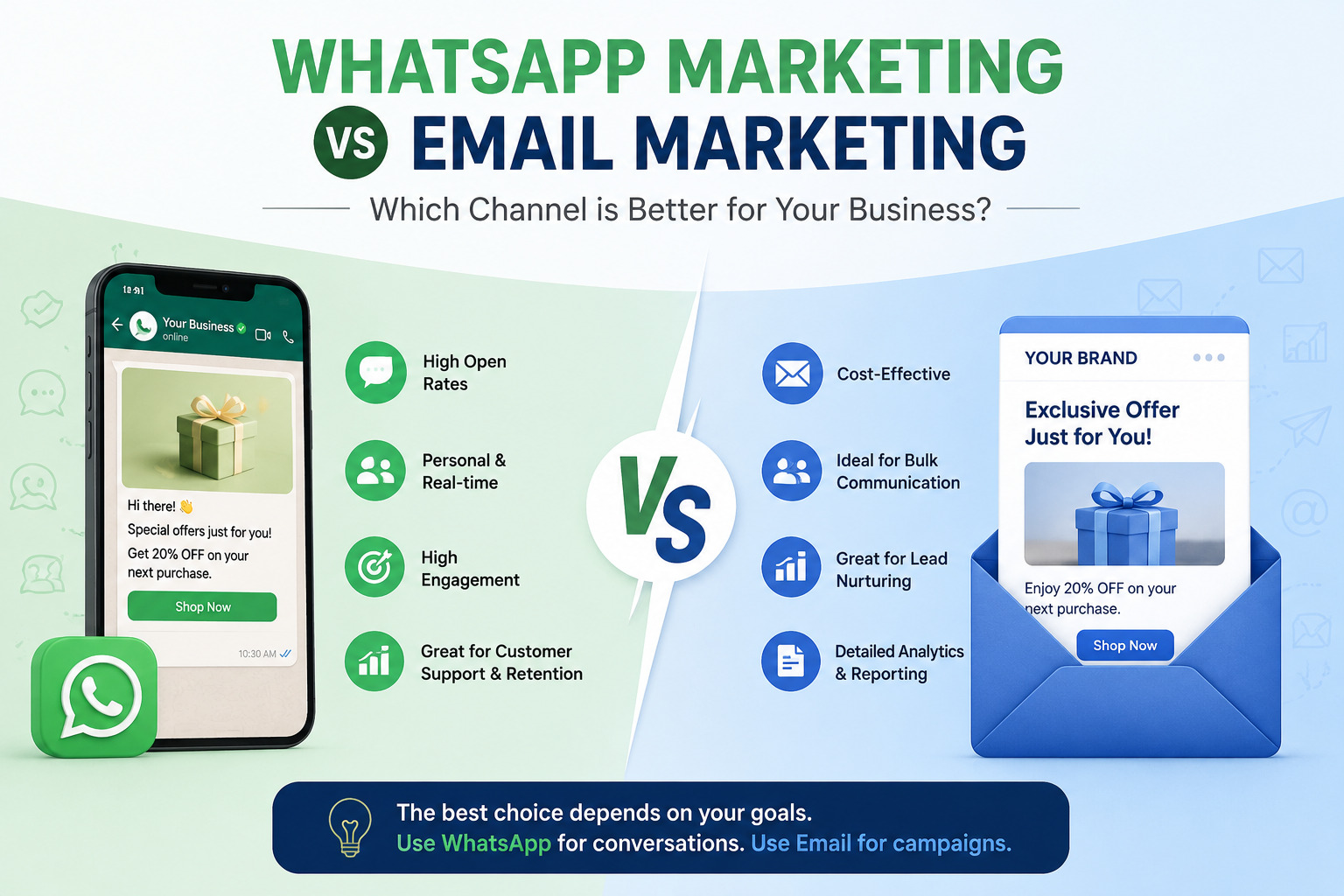
WhatsApp Marketing vs Email Marketing: Which Is Better for Business Growth
Digital marketing feels a bit like standing in a crowded marketplace where every brand is shouting for attention. Customers are flooded with notifications, promotional emails, text messages, and social media ads every single day. In this noisy environment, businesses constantly search for communication channels that actually work. Two giants dominate this conversation today: WhatsApp marketing vs email marketing. Both channels promise engagement, conversions, and customer loyalty, but they operate in completely different ways.
Table of Contents
One feels like a direct conversation with a friend sitting across the table, while the other resembles a well-crafted business letter delivered to a professional inbox. Choosing between them is not always simple because each platform shines under different circumstances. A startup trying to improve instant customer engagement may lean heavily toward WhatsApp, while a large SaaS company nurturing leads through detailed content might still depend on email automation.
The real question is not just which platform is more popular. The smarter question is: which platform delivers better results for your business goals? Open rates, click-through rates, personalization, automation, cost, trust, and scalability all play major roles in determining success. In 2026, businesses are no longer treating these channels as optional tools. They are strategic assets that shape customer relationships and revenue growth.
This detailed comparison explores every important aspect of WhatsApp vs email marketing, helping businesses, marketers, entrepreneurs, and agencies understand where each channel excels and where it falls short.
Understanding the Evolution of Digital Communication

The internet changed communication forever, but customer expectations changed even faster. Years ago, businesses could send generic promotional emails and still generate decent results. People were less overwhelmed by digital content, and inbox competition was manageable. Today, attention spans are shorter than ever, and consumers expect highly personalized experiences.
Digital communication has shifted from one-way broadcasting to real-time conversations. Customers now expect immediate answers, personalized recommendations, and human-like interactions. This shift explains why messaging apps like WhatsApp exploded in popularity for business communication. Instead of waiting hours or days for an email reply, users can instantly interact with a brand through chat.
At the same time, email marketing did not disappear. It evolved into a sophisticated ecosystem powered by automation, segmentation, AI-driven personalization, and behavioral targeting. Modern email campaigns are highly strategic. Businesses use them to nurture leads, onboard customers, recover abandoned carts, and distribute educational content.
Why Businesses Are Moving Beyond Traditional Marketing
Traditional advertising often feels like throwing darts in the dark. Television ads, billboards, and newspaper promotions cast a wide net but struggle to create direct engagement. Modern consumers prefer channels where interaction feels natural and immediate.
This is exactly why conversational marketing became so powerful. Platforms like WhatsApp create intimacy between businesses and customers. Instead of sounding like a corporate announcement, WhatsApp messages resemble personal conversations. That emotional closeness dramatically improves response rates.
Consumers also spend enormous amounts of time on mobile devices. According to Statista, WhatsApp has over 2.7 billion active users globally, making it one of the most-used communication platforms in the world. Businesses naturally follow customer behavior, and customer behavior clearly favors instant messaging.
Why Personalized Customer Messaging Matters
Imagine receiving two messages. One begins with “Dear Customer,” while the other says, “Hey Sarah, your order is arriving today.” Which one feels more engaging? Personalization transforms communication from generic noise into meaningful interaction.
Both WhatsApp and email support personalization, but WhatsApp often feels more authentic because messages appear alongside chats from family and friends. That environment increases emotional attention. Email, however, allows deeper storytelling through visuals, layouts, and long-form content.
Businesses that personalize communication effectively often see higher retention rates, stronger loyalty, and improved conversion performance. The battle between WhatsApp and email is really a battle between immediacy and depth.
What Is WhatsApp Marketing?
WhatsApp marketing refers to using WhatsApp to communicate with customers for promotions, support, updates, and engagement. Businesses commonly use the WhatsApp Business App or the WhatsApp Business API to manage customer interactions at scale.
Unlike social media platforms where algorithms decide visibility, WhatsApp messages usually land directly in front of the user. This directness is one reason WhatsApp campaigns often achieve astonishing engagement metrics. Some studies report open rates exceeding 90%, which is almost unheard of in traditional email marketing.
WhatsApp marketing works particularly well for industries where speed matters. E-commerce brands send shipping updates, restaurants confirm reservations, healthcare providers send appointment reminders, and financial services share transaction alerts.
How WhatsApp Business Works
The WhatsApp Business platform provides tools designed specifically for companies. Businesses can create profiles with contact information, product catalogs, automated greetings, and quick replies. Larger organizations use the API version to integrate customer service systems, CRMs, and chatbots.
One of the biggest strengths of WhatsApp is its conversational nature. Customers can ask questions, receive instant answers, and complete transactions inside the same interface. This frictionless experience often leads to faster purchasing decisions.
Businesses can also share multimedia content including images, PDFs, videos, voice notes, and interactive buttons. That versatility makes WhatsApp feel dynamic and engaging compared to traditional communication channels.
Types of Campaigns You Can Run on WhatsApp
WhatsApp marketing is incredibly flexible. Businesses use it for:
| Campaign Type | Purpose |
|---|---|
| Promotional Campaigns | Share discounts, flash sales, and offers |
| Customer Support | Resolve issues instantly |
| Transactional Updates | Order confirmations and delivery tracking |
| Lead Nurturing | Engage prospects through personalized chats |
| Appointment Reminders | Reduce missed bookings |
| Product Recommendations | Suggest personalized products |
The conversational style of WhatsApp creates a feeling of immediacy. Customers often respond within minutes, making the platform ideal for time-sensitive campaigns.
What Is Email Marketing?
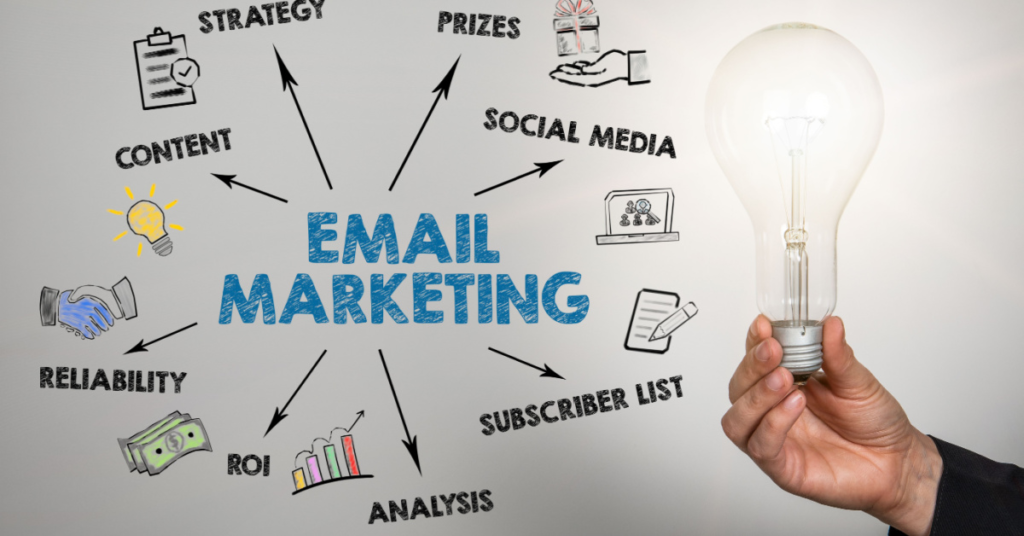
Email marketing involves sending targeted messages to subscribers through email campaigns. Despite predictions about its decline, email remains one of the highest ROI marketing channels available. According to HubSpot, businesses still generate an average return of $36 for every $1 spent on email marketing.
Email offers something WhatsApp struggles to replicate: structure. Businesses can deliver detailed newsletters, educational content, reports, onboarding sequences, and comprehensive promotional campaigns. Email creates space for storytelling and branding in ways messaging apps cannot fully match.
Another major advantage is ownership. Unlike social platforms, an email list is a business-owned asset. Brands are not dependent on changing algorithms or messaging policies in the same way they might be on other platforms.
How Email Automation Drives Revenue
Email automation is like building a digital salesperson that works around the clock. Automated sequences allow businesses to send messages triggered by customer behavior. For example, when a customer abandons a cart, an automated reminder email appears hours later.
Automation improves efficiency while maintaining personalization. Businesses can segment audiences based on demographics, purchase history, interests, or engagement behavior. This precision significantly increases conversion rates.
Advanced automation tools also integrate with analytics systems, allowing marketers to track open rates, click rates, customer journeys, and lifetime value. This data-driven environment makes email marketing highly scalable.
Popular Types of Email Campaigns
Email marketing supports a wide range of campaign styles:
- Welcome sequences
- Promotional newsletters
- Product launch announcements
- Educational drip campaigns
- Cart abandonment reminders
- Customer retention campaigns
- Event invitations
- Re-engagement emails
The flexibility of email makes it essential for businesses with longer sales cycles or complex customer journeys.
WhatsApp vs Email Marketing: Key Differences
Choosing between WhatsApp and email marketing is a bit like choosing between a phone call and a magazine. One is immediate, personal, and conversational. The other is detailed, polished, and designed for deeper storytelling. Neither is universally better because their strengths serve different marketing objectives. Businesses that understand these differences can create far more effective communication strategies.
At first glance, WhatsApp appears unbeatable because of its astonishing engagement rates. Messages are usually opened within minutes, and conversations happen naturally. Email, however, dominates when businesses need scalability, professional branding, and long-form communication. A company selling enterprise software may need educational email sequences to nurture leads over weeks, while a food delivery app may benefit more from instant WhatsApp promotions.
The customer mindset also changes depending on the platform. People check WhatsApp expecting immediate interaction. They check email expecting information. That subtle psychological difference dramatically impacts how users respond to marketing content. Sending a long corporate newsletter through WhatsApp would feel awkward, just as sending urgent delivery updates through email might feel slow and inconvenient.
Another important distinction is permission and privacy. WhatsApp communication feels more intimate because users associate the app with friends and family. Brands must be careful not to appear intrusive. Email inboxes, on the other hand, are already crowded with promotional material, making users more tolerant of marketing messages but also more likely to ignore them.
Open Rates and Engagement Levels
If engagement were a boxing match, WhatsApp would land the first punch hard. WhatsApp campaigns frequently achieve open rates above 90%, while average email open rates across industries usually range between 20% and 35%. This massive difference exists because messaging apps naturally command more immediate attention.
People often leave WhatsApp notifications enabled, and messages appear directly on lock screens. Emails frequently get buried under newsletters, promotions, and spam. Even interested customers may overlook email campaigns simply because their inboxes are overloaded.
Response speed is another huge advantage for WhatsApp. Many users reply within minutes, creating real-time conversations that accelerate decision-making. Businesses can answer objections immediately, guide purchases, and build stronger relationships.
Email engagement tends to be slower but more thoughtful. Users may spend more time reading detailed content, comparing options, or clicking through educational resources. For complex buying decisions, this slower pace can actually work in a brand’s favor.
Customer Trust and Personalization
WhatsApp feels deeply personal because it mirrors everyday human conversations. A message from a business appears in the same environment as chats from close friends and family. This creates emotional closeness but also raises expectations. Customers expect brands to communicate naturally and respectfully.
Email personalization has become extremely advanced as well. Businesses can dynamically customize subject lines, product recommendations, customer journeys, and content blocks. Modern AI-powered email platforms can predict user interests based on behavior and tailor campaigns accordingly.
The key difference lies in perception. WhatsApp personalization feels human. Email personalization feels professional. A clothing brand sending outfit recommendations through WhatsApp can create excitement similar to chatting with a personal stylist. An email campaign from the same brand might feel more polished and informative.
Trust also depends heavily on execution. Poorly timed WhatsApp messages can feel invasive, while excessive promotional emails can damage sender reputation and increase unsubscribes.
Cost Comparison for Businesses
Budget matters, especially for startups and small businesses. Email marketing is generally more affordable at scale because businesses can send thousands of emails for relatively low costs using platforms like Mailchimp, ConvertKit, or ActiveCampaign.
WhatsApp marketing can become expensive because businesses using the API often pay per conversation. Costs vary by country and conversation category, including marketing, authentication, and customer support messages.
Here’s a simplified comparison:
| Feature | WhatsApp Marketing | Email Marketing |
|---|---|---|
| Setup Cost | Moderate | Low |
| Scalability Cost | Higher | Lower |
| Automation | Available | Highly Advanced |
| Engagement Rate | Very High | Moderate |
| Long-Form Content | Limited | Excellent |
| Instant Responses | Excellent | Moderate |
For businesses prioritizing rapid engagement and customer interaction, WhatsApp costs may be justified. Businesses focused on mass communication and content distribution often find email more economical.
Deliverability and Spam Challenges
Deliverability can make or break marketing campaigns. Email marketers constantly battle spam filters, reputation issues, and crowded inboxes. Even legitimate campaigns sometimes land in promotions tabs or spam folders.
WhatsApp generally enjoys stronger deliverability because messages go directly to users. However, WhatsApp imposes strict rules to prevent spam. Businesses that send irrelevant or excessive messages risk restrictions or account suspension.
Email deliverability requires careful management involving authentication protocols like SPF, DKIM, and DMARC. Businesses must also maintain healthy subscriber lists and avoid spam-triggering behavior.
WhatsApp’s stricter environment creates higher message visibility but less flexibility. Email offers greater freedom but requires more technical optimization.
Benefits of WhatsApp Marketing
WhatsApp marketing has exploded because it matches modern consumer behavior perfectly. People crave speed, convenience, and conversational experiences. Instead of waiting hours for replies, users want instant interaction, much like talking to a store employee in real time.
The platform also removes friction from customer communication. Users don’t need to open browsers, fill forms, or navigate complicated websites. A simple message can initiate a purchase, solve a problem, or confirm a booking.
This simplicity is incredibly powerful. In a world overloaded with digital complexity, convenience often wins.
Faster Customer Responses
Speed influences buying decisions more than many businesses realize. Customers often purchase from the first brand that answers their questions clearly and quickly. WhatsApp creates a direct line between businesses and consumers, dramatically reducing response times.
Imagine a customer browsing an online furniture store late at night. They have questions about dimensions, delivery options, and materials. An automated WhatsApp assistant can respond instantly, preventing hesitation and keeping the buying momentum alive.
Fast responses also improve customer satisfaction. Support interactions feel less frustrating when users can resolve issues through quick chat conversations instead of waiting on hold or navigating endless email threads.
Many businesses report significant increases in conversion rates after implementing WhatsApp customer support because buyers feel guided rather than abandoned.
Better Mobile Engagement
Modern internet usage revolves around mobile devices. WhatsApp was built mobile-first, making it naturally optimized for smartphone engagement. Messages are easy to read, notifications are immediate, and interactions feel seamless.
Email is mobile-friendly today, but it still originated in a desktop-centric era. Long email layouts, image-heavy newsletters, and complex formatting can sometimes reduce usability on smaller screens.
WhatsApp communication feels lightweight and effortless. Customers can quickly consume content while commuting, shopping, or relaxing at home. This accessibility contributes heavily to high engagement rates.
Voice notes, quick replies, clickable buttons, and media sharing also create richer interactions. Brands can combine text, images, videos, and direct conversations in ways that feel natural rather than promotional.
Benefits of Email Marketing
Despite the rapid rise of messaging apps, email remains one of the most reliable and profitable marketing channels in the world. Businesses continue investing heavily in email because it delivers consistent ROI, supports complex customer journeys, and scales efficiently.
Email also provides unmatched flexibility for content depth. Brands can educate, persuade, entertain, and nurture customers over extended periods. This makes email particularly valuable for industries involving high-ticket products, B2B services, or long decision-making cycles.
Long-Form Communication and Branding
Some stories simply need more space. Email gives businesses room to explain ideas, showcase expertise, and build emotional connections through thoughtful storytelling.
A financial consulting firm, for example, may send detailed market insights and investment advice through email newsletters. Trying to compress that information into WhatsApp messages would feel restrictive and fragmented.
Email also supports sophisticated branding through layouts, colors, typography, banners, and design consistency. This polished presentation strengthens brand identity and professionalism.
Customers often perceive well-designed email campaigns as more authoritative and trustworthy for detailed information. Industries like education, healthcare, software, and finance especially benefit from this structured communication style.
Scalability and Automation Power
Email automation is one of the most powerful tools in digital marketing. Businesses can create entire customer journeys that run automatically based on user behavior.
For example, an online course creator might build this sequence:
- Welcome email
- Free educational resource
- Customer success story
- Product demonstration
- Limited-time discount
- Follow-up reminder
This automated process can nurture thousands of leads simultaneously without requiring manual conversations.
Advanced segmentation also allows businesses to send highly targeted campaigns. A fitness brand can recommend different products based on customer goals, age groups, or purchase history.
The scalability of email marketing makes it ideal for businesses managing large audiences or complex funnels.
When Businesses Should Use WhatsApp Instead of Email
Not every marketing message belongs in an inbox. Some messages demand immediacy, personal interaction, and conversational flow. That is where WhatsApp becomes incredibly valuable. Businesses that rely on rapid customer communication often achieve far better results through messaging platforms than traditional email campaigns.
Industries built around urgency naturally benefit from WhatsApp. E-commerce stores use it for order confirmations, shipping updates, and flash sales. Healthcare providers send appointment reminders and prescription notifications. Restaurants confirm reservations and share delivery updates. Travel agencies provide real-time itinerary changes and customer support.
The key advantage lies in attention speed. A WhatsApp notification usually interrupts the user immediately, much like a text message from a friend. Email rarely creates that same urgency. Customers may check their inbox hours later, long after the opportunity has passed.
Businesses should also prioritize WhatsApp when customer interaction is central to the buying process. Products requiring quick clarifications, customized recommendations, or support-driven conversions perform extremely well through conversational marketing. Imagine a skincare brand helping customers choose products based on skin type through live chat. That experience feels personal and interactive, almost like speaking with a beauty consultant inside a store.
Another major use case involves customer retention. Brands can send personalized birthday wishes, loyalty rewards, or restock reminders that feel warm rather than robotic. These small interactions strengthen emotional connections with customers and increase long-term loyalty.
WhatsApp also shines in regions where mobile messaging dominates internet behavior. In countries like India, Brazil, Indonesia, and parts of Europe, WhatsApp is deeply embedded in daily life. Customers often trust WhatsApp communication more than email because it feels familiar and accessible.
Still, businesses must approach WhatsApp carefully. Sending excessive promotional messages can quickly damage trust. Because the platform feels personal, intrusive marketing creates stronger negative reactions than unwanted emails. Success depends on relevance, timing, and genuine customer value.
When Email Marketing Is the Better Choice
Email marketing remains unmatched for certain business goals, especially when communication requires depth, structure, and scalability. While WhatsApp excels at immediacy, email dominates in situations where businesses need to educate, nurture, and persuade customers over longer periods.
Complex sales funnels are one of email’s greatest strengths. Consider a SaaS company selling enterprise software. Customers rarely make decisions instantly. They need product demos, educational guides, case studies, feature comparisons, and onboarding materials. Email allows businesses to organize this information into structured campaigns that gradually build trust and authority.
Content-heavy industries also benefit enormously from email marketing. Media companies, educators, consultants, and financial institutions often distribute newsletters packed with insights and analysis. These communications would feel cluttered and overwhelming inside a messaging app.
Email is also ideal for professional branding. Businesses can carefully design campaigns using branded templates, visuals, headers, and typography that reinforce credibility. A law firm or investment company typically appears more authoritative through polished email communication than casual chat messages.
Another powerful advantage is ownership and data control. Email lists are long-term business assets. Brands can export subscriber data, integrate with CRM systems, and maintain direct audience access regardless of social platform changes. Messaging platforms, including WhatsApp, operate under stricter platform rules and policy limitations.
Automation capabilities further strengthen email’s position. Businesses can build sophisticated workflows triggered by customer behavior, website visits, purchases, or engagement patterns. These automated systems can nurture leads for weeks or months without manual involvement.
Email also supports broader communication formats:
| Communication Need | Best Channel |
|---|---|
| Detailed Educational Content | |
| Instant Customer Support | |
| Weekly Newsletters | |
| Flash Sales | |
| Product Tutorials | |
| Order Updates | |
| Lead Nurturing Funnels | |
| Personalized Offers |
The reality is simple: email thrives when businesses need depth, professionalism, and scalable automation.
Combining WhatsApp and Email for Maximum ROI
The smartest marketers no longer ask whether WhatsApp is better than email. Instead, they ask how both channels can work together. Combining WhatsApp and email creates a marketing ecosystem where each platform compensates for the other’s weaknesses.
Think of email as the library and WhatsApp as the conversation happening outside the library doors. Email stores detailed knowledge, while WhatsApp creates instant interaction. Businesses that integrate both channels often achieve dramatically stronger customer engagement and conversion performance.
A customer journey might begin with an email campaign offering a free guide or webinar. After signing up, the customer receives WhatsApp reminders about upcoming events, personalized support, or limited-time offers. This multi-channel experience feels seamless and highly engaging.
E-commerce brands use this strategy effectively. Email campaigns showcase products through rich visuals, storytelling, and recommendations. WhatsApp then handles abandoned cart reminders, order confirmations, customer questions, and shipping updates. The result is a smoother customer experience from discovery to purchase.
Automation platforms now allow businesses to coordinate both channels intelligently. For example:
- A customer opens an email but does not purchase.
- The system triggers a personalized WhatsApp follow-up.
- The customer clicks the WhatsApp message and asks questions.
- A sales representative responds instantly.
- The purchase is completed.
This coordinated communication dramatically increases conversion opportunities.
Another major advantage involves customer segmentation. Businesses can reserve WhatsApp for high-intent interactions while using email for broader content distribution. This prevents messaging fatigue while maintaining engagement across multiple touchpoints.
Here’s how many successful brands divide responsibilities:
| Marketing Function | Preferred Channel |
|---|---|
| Educational Content | |
| Time-Sensitive Promotions | |
| Customer Support | |
| Product Launch Campaigns | Email + WhatsApp |
| Loyalty Programs | Both |
| Transactional Updates | |
| Long-Term Lead Nurturing |
Omnichannel marketing works because customers behave differently depending on context. Sometimes they want detailed information. Other times they want instant answers. Businesses that adapt to both needs build stronger customer relationships and maximize revenue potential.
According to recent marketing studies, brands using multi-channel engagement strategies often see higher retention rates and significantly improved customer lifetime value compared to single-channel campaigns. Consumers appreciate flexibility, and integrated communication creates a more human experience.
Conclusion
The debate between WhatsApp vs email marketing does not have a one-size-fits-all winner because both platforms solve different communication problems. WhatsApp dominates when businesses need immediacy, high engagement, conversational interaction, and mobile-first communication. Email excels when brands require detailed storytelling, scalable automation, professional presentation, and long-term customer nurturing.
WhatsApp feels like a quick, personal conversation inside a crowded café. Email resembles a carefully prepared presentation delivered in a conference room. One creates speed and intimacy. The other creates depth and structure.
Businesses focused on rapid customer support, transactional updates, flash sales, and personalized engagement often achieve exceptional results with WhatsApp marketing. Brands operating complex sales funnels, educational campaigns, and content-driven strategies continue to depend heavily on email marketing.
The most successful companies in 2026 are not choosing one channel while ignoring the other. They are combining both strategically. Email builds knowledge and trust over time, while WhatsApp creates immediate interaction and action. Together, they form a powerful communication engine capable of increasing engagement, loyalty, and revenue.
Digital marketing keeps evolving, but one principle remains constant: customers respond best when communication feels relevant, timely, and human. Whether through a carefully crafted email sequence or a quick WhatsApp message, businesses that prioritize customer experience will always outperform those focused only on broadcasting promotions.